

It has become increasingly difficult to dispute that the country is experiencing its most severe economic crisis since gaining independence in 1964. The hyperinflation ravaging the nation is not merely a symptom but a glaring indicator of deep-rooted structural failures that have pushed millions of Malawians to the brink of despair.
In this article, the Malawi Spotlight explores the intricate and challenging economic crisis currently plaguing Malawi. The nation grapples with a multitude of issues, ranging from soaring inflation rates to a significant decline in agricultural productivity, which is the backbone of its economy.
As the government struggles to implement effective policies and attract foreign investment, many citizens face increasing hardships, with rising unemployment and dwindling resources further exacerbating the situation.
This analysis aims to shed light on the complexities of Malawi’s economic landscape, providing a comprehensive overview of the factors contributing to this dire predicament and the potential paths forward.
Hyperinflation Grips the Nation
According to the latest report from EY Global, Malawi remains trapped in hyperinflation, with the International Monetary Fund reporting a staggering three-year cumulative inflation rate of 116% as of December 2024. The consultancy firm projects cumulative rates of 102% and 66% for 2025 and 2026 respectively, indicating that whilst the situation may gradually improve, Malawians will continue to suffer from uncontrollably rising prices well into the future.
The National Statistics Office corroborates these alarming figures, reporting a three-year cumulative inflation rate of 118% and a 12-month rate of 30% as of March 2025. Despite a slight easing from the peak of 30.7% reached in February 2024, inflation remains at catastrophic levels that are decimating household purchasing power.
For ordinary Malawians like Flossy Katsonga, a mother of five from Blantyre who sells rosaries, these statistics translate into daily hardship. As reported by Nation Online, she faces margins of just K300 per rosary whilst input costs continue to soar, making it increasingly difficult to support her family and contribute to household expenses.
Currency Collapse and Foreign Exchange Crisis
The Malawian kwacha has become a casualty of this economic catastrophe. According to Great Lakes Crisis, the currency has lost well over half its value since 2022, with major devaluations of approximately 25% in 2022 and 44% in late 2023. Yet the currency continues to trade at a significant black-market premium, with rates hitting K5,000 per dollar compared to the official rate of K1,751.
This foreign exchange shortage has created a vicious cycle. As BBC reports, businesses seeking to import essential goods find themselves unable to secure US dollars from banks, forcing them to turn to the black market where rates exceed 4,000 kwacha for one dollar. These inflated costs inevitably filter down to consumers, further fueling the hyperinflationary spiral.
The severity of the forex crisis becomes apparent when we consider that official reserves have fallen below one month of import cover, creating crippling shortages of fuel and basic goods. At one point, according to Great Lakes Crisis, the country had only five days of petrol and 15 days of diesel stock—far short of the 90-day buffer required for economic stability.
Unprecedented Economic Decline
The numbers paint a devastating picture of economic decline. Real GDP growth has plummeted to just 1.8% in 2024, according to the World Bank’s Economic Monitor, marking the fourth consecutive year of per capita income contraction. This growth rate falls well below the population growth rate of 2.6%, meaning the average Malawian is becoming progressively poorer.
The ISS African Futures analysis reveals that Malawi’s GDP per capita of US$1,436 in 2023 remains significantly below the US$1,814 average for low-income African nations. More alarmingly, the country is projected to maintain this gap through 2043, reaching only US$2,242 compared to the projected average of US$2,986 for similar economies.
Public debt has spiraled to unsustainable levels, reaching 88% of GDP by the end of 2024, according to the IMF’s Article IV Consultation. The interest bill on public debt is estimated to be approaching 7% of GDP, severely constraining the government’s ability to invest in productive sectors or provide essential services.
Deepest Poverty Crisis in Decades
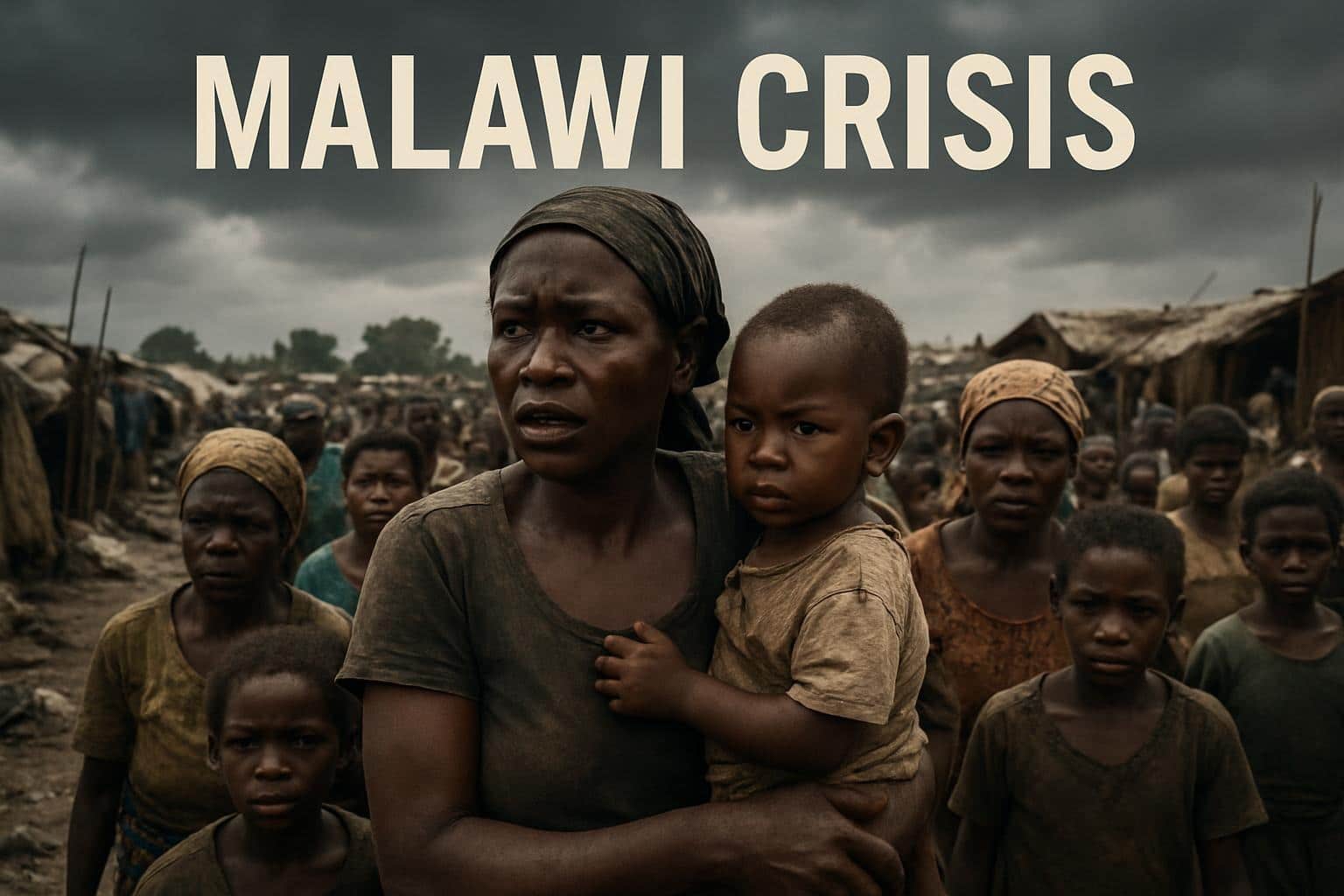
The human cost of this economic meltdown is staggering. The World Bank now estimates that 75.4% of Malawians live below the revised international poverty line of $3 per day, whilst 70% survive on less than $2.15 daily. This represents approximately 15.8 million people living in extreme poverty.
Even more concerning, the World Bank projects that an additional 417,000 Malawians will fall into poverty in 2025 alone, as the economic situation continues to deteriorate. The country now ranks among the world’s poorest nations, with Global Finance Magazine placing it seventh globally in terms of economic deprivation.
Food Insecurity Reaches Crisis Levels
The economic collapse has triggered a humanitarian catastrophe. According to FEWS NET, approximately 5.7 million Malawians—nearly a third of the population—are facing crisis-level food insecurity in 2025. This represents a 30% increase from the previous year, making it one of the worst hunger crises in the nation’s history.
The situation is particularly dire in southern districts where, as reported by FEWS NET, the 2025 harvest is estimated to be 65-75% below the five-year average. Poor households are experiencing food consumption deficits two months earlier than normal, with needs expected to increase atypically early towards the end of 2025.
The World Food Programme indicates that up to 3.5 million people are chronically food insecure, whilst up to 40% of the population have been affected by El Niño-induced drought conditions that devastated agricultural production.
Political and Institutional Challenges
As Malawi approaches its general elections on 16 September 2025, the economic crisis has become the defining issue. According to Afrobarometer, 58% of Malawians identify food shortage or famine as the most pressing problem requiring government intervention, highlighting how the economic crisis has translated into immediate survival concerns.
President Lazarus Chakwera, who came to power in 2020 promising a “new dawn,” now faces widespread disillusionment. As ISS Africa notes, his political capital is rapidly eroding as he has “delivered too little and disappointed many, particularly over corruption, nepotism and fighting grinding poverty.”
The president’s pledge to create one million jobs, according to Great Lakes Crisis, “remains widely derided as a national punchline amid rampant unemployment and underemployment.” Corruption remains deeply ingrained, with critics arguing that nepotism and cronyism have re-emerged in appointments whilst independent bodies like the Anti-Corruption Bureau have been undermined.
International Support Wanes
Adding to Malawi’s woes, the IMF Extended Credit Facility automatically terminated on 14 May 2025, eighteen months after approval without completing a review. Only $35 million of the $175 million programme had been disbursed, cutting off a crucial lifeline for the struggling economy.
The suspension of USAID funds by the US administration in early 2025 has further compounded the crisis, halting essential medical supplies and educational support. The US previously contributed over $350 million annually, constituting more than 13% of Malawi’s budget.
Historical Context: The Worst Crisis Since Independence
When we examine Malawi’s economic trajectory since independence in 1964, the current crisis stands out as uniquely severe. The German Ministry for Economic Cooperation describes the situation as “probably its biggest economic crisis since gaining independence,” whilst the World Bank characterises the economy as being “in a deep and protracted crisis marked by elevated inflation, declining living standards, and high rates of food insecurity.”
Former Reserve Bank Governor Dr Dalitso Kabambe, now a presidential candidate, has been particularly scathing in his assessment. According to AllAfrica, he describes the economy as “shambolic and in disaster,” arguing that the country faces “the worst GDP growth rate Malawi has achieved since independence.”
The confluence of factors—hyperinflation, currency collapse, foreign exchange shortages, food insecurity, and political instability—creates a perfect storm that distinguishes this crisis from previous economic challenges. Unlike past difficulties that were typically driven by single factors such as weather events or external shocks, the current crisis represents a comprehensive breakdown of economic systems and governance structures.
The Path Ahead
As we approach the September 2025 elections, the question is not whether Malawi is experiencing its worst-ever economic crisis—the evidence overwhelmingly suggests it is—but rather whether the political process can generate the leadership and policies necessary to reverse this devastating decline.
The hyperinflation ravaging the country is indeed a symptom of deeper structural failures, but it is also an urgent crisis requiring immediate attention. With three-quarters of the population living in poverty, millions facing food insecurity, and basic economic indicators at their worst levels since independence, Malawi stands at a critical juncture that will determine whether the country can pull back from the brink or sink deeper into economic despair.
The upcoming elections may provide an opportunity for course correction, but as our analysis suggests, the challenges are so profound that recovery will require not just new leadership but a fundamental transformation of how the country approaches economic governance, fiscal management, and development strategy. The hyperinflation crisis is not just a sign of the worst-ever economic crisis—it is a clarion call for urgent, comprehensive action to prevent further deterioration of an already desperate situation.