Malawi’s disability sector tells two different stories right now. On paper, the country has made real progress. A new disability rights law is in place. A national policy backs it up. Advocacy groups are more vocal than ever.
But life on the ground moves much slower. In 2026, that gap showed up again and again. A Member of Parliament wants hard quotas in schools and farming support. Malawi’s Human Rights Commission is demanding action for roughly 400,000 Deaf citizens. A private foundation stepped in for one family after government support did not reach them.
These stories point to the same conclusion. Malawi has made real gains on disability rights. But those gains still fall short of the scale of exclusion they aim to fix.
A disability rights law, still being built
Malawi took a big step for disability rights in February 2024. President Lazarus Chakwera signed the Persons with Disabilities Act into law. It took effect that April.
The law replaced old legislation from decades earlier. It rests on three ideas: equal opportunity, non-discrimination, and accessibility. In 2025, government followed up with a National Disability Policy to put those ideas into practice.
Malawi’s Human Rights Commission points to both as real wins. It also credits the new Malawi Sign Language Dictionary. Together, these are meant to show that the legal groundwork for inclusion is finally in place.
But the money tells a different story. UNICEF Malawi’s disability budget analysis found government spending on disability programmes fell to about 0.15 percent of total spending in 2024/25. That is down from 0.19 percent the year before.
The Disability Trust Fund was set up to channel money straight to the sector. Between 2019/20 and 2022/23, it received more than MK375 million. Reports say it paid out none of it.
At the Malawi Council for Disability Affairs, budget records show a similar pattern. About 80 percent of its 2024/25 budget went to staff costs. Only around a fifth was left for actual programmes.
Advocates keep coming back to this point. The laws and policies exist. The money to make them work usually does not.
Where inclusion breaks down: school and childhood
Malawi’s classrooms show the gap between policy and practice most clearly.
The 2018 census found 5.6 percent of children aged five to seventeen live with a disability, according to the figures in an article, “Children with Disabilities in Malawi,” compiled by Child Rights Information and Documentation Centre (CRIDOC). That is more than double the 2.4 percent recorded ten years earlier. A 2019 survey found 12 percent of children aged two to seventeen have some functional difficulty. Most involve sight, movement, or hearing.
Yet children with disabilities make up only 3.3 percent of primary school enrolment. In secondary school, the figure drops to 2.2 percent. They also drop out at a higher rate: 15.7 percent, compared with 13.2 percent for children without disabilities.
The risks go beyond the classroom door. Research from the African Journal of Disability, plus a joint Malawi-Uganda study, found that 84 percent of children with disabilities faced violence at school within a single week. Girls with disabilities reported sexual violence from school staff at nearly five times the rate of other girls. A 2023 review by the UN Committee on the Rights of Persons with Disabilities flagged this as a serious concern.
This is the backdrop to a proposal from Matthews Mtumbuka, MP for Rumphi Central. He argues Malawi needs to move past “equal access” as a policy goal. In his view, it has not produced equal outcomes.
Nyasa Times reported that Mtumbuka wants a guaranteed share of school places set aside for people with disabilities. He wants the same for farming subsidies and social protection programmes. Without targeted steps, he warns, “the existing gap between the disabled and non-disabled populations will only continue to widen.”
His plan would need changes to current education and social protection rules. But it reflects a wider argument now spreading among Malawian disability advocates. Equal access on paper means little when children with disabilities already start from behind.
Malawi’s Deaf community and the fight for disability rights
Two dates fell together this September. The International Week of Deaf People ran from 21 to 27 September. The International Day of Sign Languages fell on 23 September.
Malawi’s Human Rights Commission used the moment to issue one of its sharpest statements this year on disability rights. The Commission, led by Executive Secretary Habiba Osman, put the number of Deaf and hard-of-hearing Malawians at about 400,000.
It listed five problems this community still faces. Healthcare access is difficult. Education is often poor quality or excludes them outright. Courts and police rarely offer support. Jobs are scarce. Public information and media leave them out too.
The statement did give credit where due. It named the 2024 Persons with Disabilities Act and the new Malawi Sign Language Dictionary as real achievements.
It also set out five clear demands. Send certified sign language interpreters to clinics, police stations, and courts. Train more specialist teachers. Enforce job quotas for people with disabilities. Require sign language interpretation on television. Fund disability programmes consistently, not on an ad hoc basis.
These demands went to specific ministries: education, labour, finance, and gender, children, disability and social welfare. The Malawi Communications Regulatory Authority was named too.
The level of detail matters. Rather than treating Deaf inclusion as a general disability issue, the Commission named exact failures in exact places: courtrooms, clinics, classrooms, and newsrooms. Malawi’s current laws have only partly addressed any of them.
Disability rights at work: the limits of “equal access”
Employment sits at the centre of Malawi’s disability rights debate.
In May 2026, the Federation of Disability Organisations in Malawi, known as FEDOMA, took part in a consultation on Malawi’s Universal Periodic Review recommendations. Its chairperson, Mapopa Mgombera Shaba, did not hold back. “As FEDOMA, we are not impressed with the way things are moving regarding the rights and freedoms of persons with disabilities,” he said.
He pointed to hiring practices directly. “When you go to both private and government institutions, not many people with disabilities are employed,” he said.
Elizabeth Machinjiri, who lives with albinism, attended the same consultation. Her message was blunt. “Government should review the disability policies,” she said, adding that “these provisions exist only on paper.” She also raised a harder issue: people with albinism in Malawi still face real risk of violence and abduction.
That same argument came up again in September 2026, when Sightsavers and FEDOMA held a strategy workshop in Blantyre. Their goal: get Malawi to write the African Disability Protocol into national law.
“We need to move beyond commitments on paper and ensure that the African Disability Protocol becomes part of our national legal framework on disability rights,” said Naomi Kalua, a Sightsavers programme officer.
FEDOMA’s executive director, Simon Munde, framed it as a legal audit. “We need to identify the gaps in our laws and make the necessary changes so that the voices of people with disabilities, especially women, are not left out,” he said.
Mercy Gusto of the Disabled Women and Orphans Organisation pushed the point further. Women with disabilities face both gender bias and disability stigma, she said. They need an active role in shaping how the protocol works, not a passive one.
When the state falls short, families and foundations step in
Budget lines and disability rights policy statements, especially in times of rising economic hardships, can feel abstract. Laina Chamveka Phiri’s story makes the problem real.
Laina has lived with a long-term mobility impairment since 2017. She went through physiotherapy at Kachere Rehabilitation Centre in the years that followed.
On 31 August 2026, the Jane Ansah Foundation stepped in. It gave her family blankets, maize flour, sugar, soap, and financial help. A relative, Bernadeta Chamveka Phiri, had connected them to the Foundation.
“We are personally and particularly very thankful for the kind gesture,” Laina’s sister said, according to Pan African Visions. Lewis Kamundi, the Foundation’s director of operations, said it plans to keep reaching families like this one. He pointed to the barriers households with a disabled member face when trying to access government support.
One case does not prove the whole system is failing. But it fits a pattern advocates keep describing. The Disability Trust Fund sits underfunded. Disability-specific budget lines stay thin. In practice, private charity often fills the gap public programmes were built to close.
Changing the narrative: training journalists to report inclusively
Disability rights advocates are not only focused on what gets covered. They also care how it gets covered.
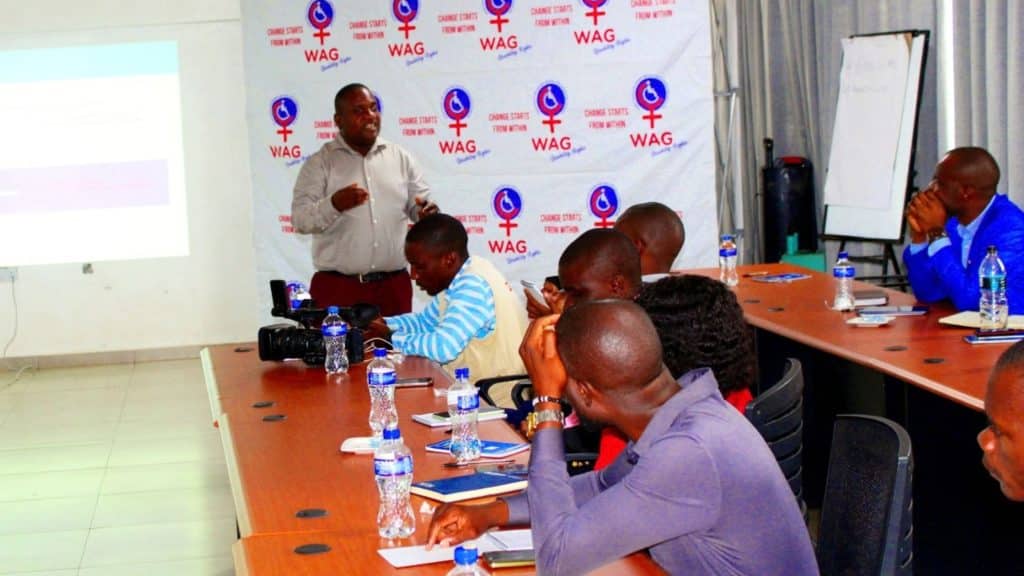
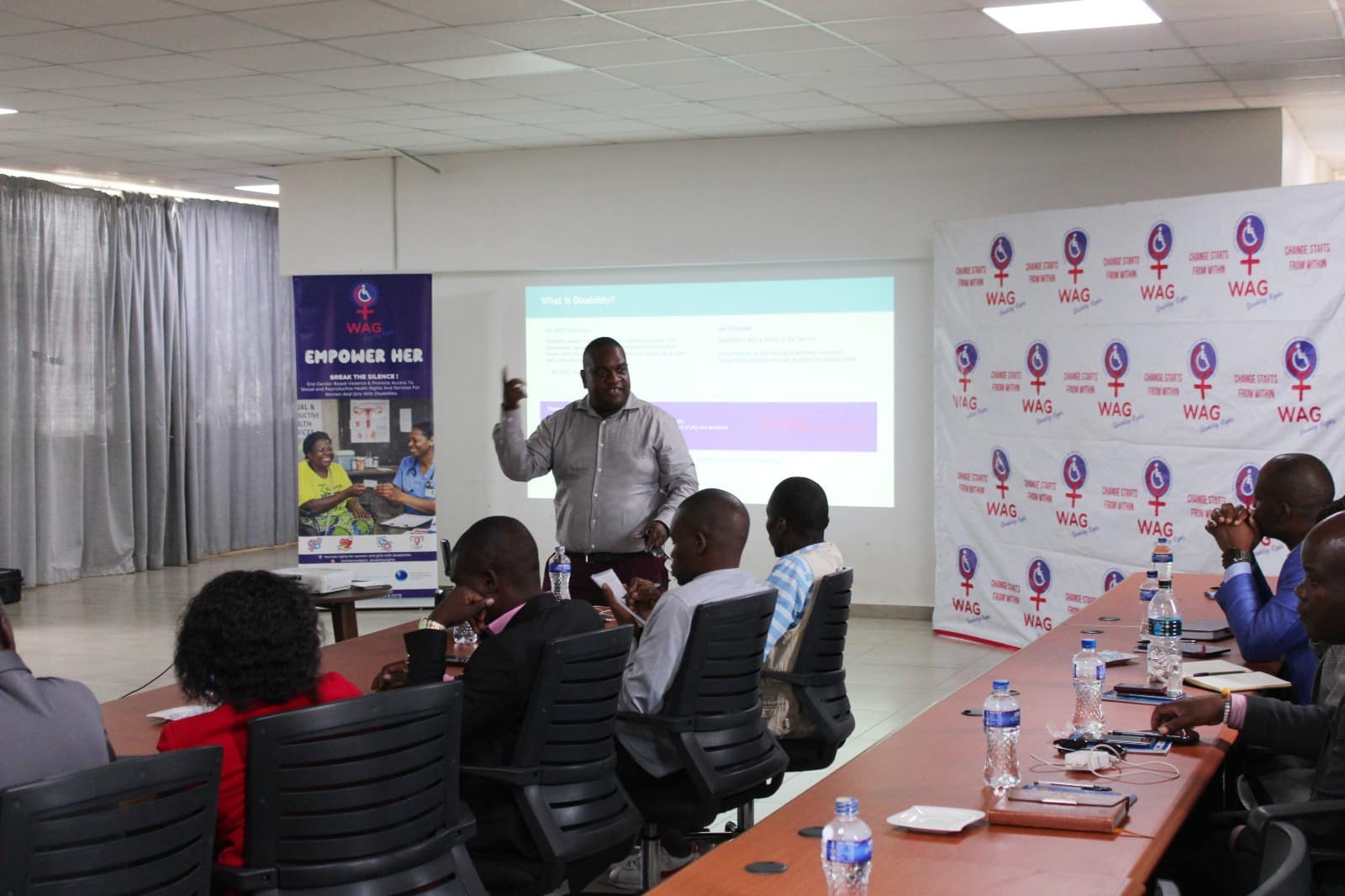
On Tuesday, 31 March 2026, Women and Girls with Disabilities, known as WAG Disability Rights, trained journalists in Lilongwe. The focus was respectful, accurate disability reporting. That included correct terminology and new Chichewa words for disability topics.
“Media has a critical responsibility to disseminate accurate and balanced information on disability-related issues,” said Bridget Oscar Phiri, WAG’s project lead. She also announced plans to build a network across media houses, to close gaps in reporting and communication.
Facilitated by Disability Policy Specialist and Non-profit Management Expert Dr George Mwika Kayange, the training sits within WAG’s wider Empower-Her Project. It runs from 2024 to 2029 across Lilongwe’s Kauma, Area 23, and Senti neighbourhoods. The project tackles sexual and reproductive health access and gender-based violence facing women and girls with disabilities.
The reasoning is simple. Coverage that gets language wrong can deepen stigma. Coverage that gets it right can shift public attitudes in ways laws alone cannot. Journalists who attended said they left with skills they had lacked. It is a small sign that Malawi’s media, like its government, is still learning what disability-inclusive coverage takes.
What 2026 adds up to
Put side by side, this year resists a simple verdict.
Malawi now has a disability rights act. It has a national policy, a sign language dictionary, and a human rights commission willing to name specific failures instead of speaking in general terms.
It also has a Disability Trust Fund that has reportedly paid out none of the hundreds of millions of kwacha it holds. It has a disability affairs council spending most of its budget on salaries, not programmes. And it has an MP arguing that “equal access” itself needs a rethink, because it has not delivered equal outcomes.
Groups like FEDOMA, Sightsavers, the Disabled Women and Orphans Organisation, and WAG Disability Rights are converging on one point. Legal recognition is a floor, not a ceiling.
Closing the gap between what Malawi’s laws promise and what people with disabilities actually experience will take money and political will. So far, both have only partly shown up.
What happens next will decide a lot. Will the African Disability Protocol get written into national law? Will employment quotas move from a demand to an enforced rule? Will the Disability Trust Fund start paying out the money it holds?
The answers will decide how 2026 gets remembered. Either as the year Malawi’s disability sector turned a corner. Or as the year it simply wrote down, in more detail than before, how far it still has to go.